
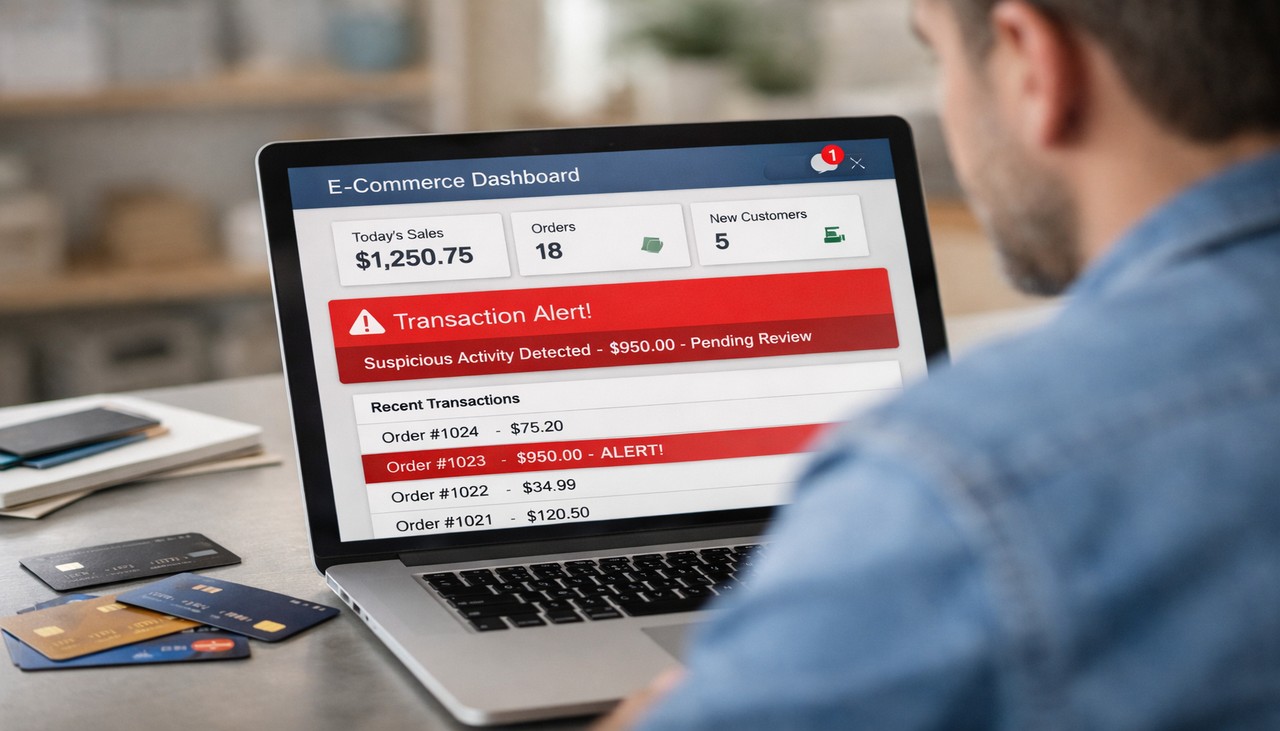

TL;DR: E-commerce chargebacks are projected to hit 337 million globally by 2026, costing merchants over $100 billion. Roughly 75% of all chargebacks stem from "friendly fraud" — customers disputing legitimate purchases — not actual stolen cards. Small e-commerce businesses can fight back with clear billing descriptors, proactive customer communication, tools like Visa Compelling Evidence 3.0, and chargeback alert services. This guide breaks down every reason code category, walks through your prevention options, and explains how your choice of payment processor directly affects your chargeback exposure.
A chargeback is not just a refund. When a customer disputes a transaction with their bank, the merchant loses the sale amount, pays a chargeback fee (typically $20 to $100 per incident), loses the product if it already shipped, and absorbs the operational cost of fighting the dispute. According to research compiled by Ringly.io, U.S. merchants now lose $4.61 for every $1 of fraud — a 32% increase since 2022.
The numbers at scale are staggering. Chargeflow's 2025 chargeback statistics report projects that global chargeback volume will reach 337 million transactions by 2026, a 42% increase from 2023 levels. In the U.S. alone, chargeback volume is estimated at 146 million transactions valued at $15.3 billion. For small e-commerce businesses operating on thin margins, even a handful of chargebacks per month can erode profitability and threaten your ability to keep your merchant account.
| Cost Component | Typical Range |
|---|---|
| Chargeback fee (per incident) | $20–$100 |
| Lost merchandise value | Full product cost |
| Shipping costs (non-recoverable) | Varies |
| Operational/labor cost per dispute | $30–$75 in staff time |
| Total cost multiplier per $1 of fraud | $4.61 (U.S. average) |
Here is the part most small business owners do not realize: the majority of chargebacks are not from stolen credit cards. A survey by Chargebacks911 published in FF News found that 45% of all chargebacks stem from friendly fraud on average, and major card networks like Visa and Mastercard report that number can reach 75% for some merchants. Friendly fraud happens when a real customer makes a real purchase and then disputes it anyway.
Why do they do it? Sometimes they genuinely do not recognize the charge on their bank statement because your billing descriptor says "PYMT*ACME LLC" instead of your store name. Sometimes they forgot about a subscription renewal. Sometimes their kid made a purchase on their phone. And sometimes — increasingly — they simply want free merchandise. Payscout reported that retail e-commerce chargebacks surged 233% between Q1 and Q3 of 2025, driven partly by "refund hack" tutorials circulating on social media, with 1 in 5 consumers justifying filing false claims.
Forecasts from the Sift Q4 2025 Digital Trust Index project a 40% rise in friendly fraud cases by 2026. Fighting friendly fraud requires a completely different strategy than fighting actual card theft — and it is a fight you can actually win.
Every chargeback comes with a reason code assigned by the card network (Visa, Mastercard, Amex, or Discover). These codes tell you exactly what the cardholder is claiming went wrong, and they dictate what evidence you need to fight the dispute. Understanding them is the first step to building a defense. According to Chargeback.io's reason code guide, the codes fall into four broad categories:
| Category | What the Customer Claims | Common Examples | Visa Code Examples |
|---|---|---|---|
| Fraud | "I did not make this purchase" | Friendly fraud, actual stolen card | 10.4 (Card-Absent Fraud) |
| Authorization | "This was not properly authorized" | Expired card charged, declined then processed | 11.1, 11.2, 11.3 |
| Processing Errors | "I was charged the wrong amount" | Duplicate charge, wrong amount, currency error | 12.1, 12.2, 12.5 |
| Consumer Disputes | "I did not receive what I paid for" | Item not received, defective, not as described | 13.1, 13.2, 13.3 |
Why this matters for your prevention strategy: if most of your chargebacks are reason code 10.4 (fraud — card-absent environment), you are likely dealing with friendly fraud and should focus on transaction documentation and Visa's Compelling Evidence 3.0 program. If you are seeing 13.1 (merchandise not received) codes, your shipping and tracking process needs attention. The reason code is your diagnostic tool — it tells you where your business is leaking money.
Visa Compelling Evidence 3.0 (CE3.0), introduced in April 2023 and expanded with automatic qualification in October 2025, gives merchants a powerful tool specifically designed to combat friendly fraud filed under reason code 10.4. The core idea is simple: if you can prove that the same device or IP address was used in two previous undisputed transactions with your store, Visa will consider that compelling proof the cardholder made the disputed purchase.
Here is how it works in practice. When a customer disputes a charge as fraudulent, you submit two prior transactions from the same customer that share at least two matching data elements — such as IP address, device fingerprint, or shipping address — with the disputed transaction. Those prior transactions must be between 120 and 365 days old and must not have been previously disputed. If the evidence matches, Visa will reverse the chargeback.
CE3.0 also works pre-dispute through Visa Order Insight. When a cardholder initiates a dispute, Visa can automatically check for qualifying historical transactions before the chargeback is even filed, potentially blocking it entirely. For subscription businesses and stores with repeat customers, this is a significant shift in your favor. The key requirement is that you must be collecting and storing device fingerprints and IP addresses with every transaction — if you are not doing this today, start immediately.
Prevention is dramatically cheaper than fighting disputes after the fact. Based on guidance from AltoPay's merchant chargeback guide and PayCompass's reason code analysis, here are the highest-impact prevention tactics for small e-commerce businesses:
Use a recognizable billing descriptor. This single change eliminates a surprising number of "I don't recognize this charge" disputes. Your billing descriptor should match your store name, not your legal entity name. If your website is "SunnySideShop.com" but your billing descriptor reads "PYMTS*SSL HOLDINGS LLC," customers will dispute it.
Send pre-charge notifications for subscriptions. Notify customers 3–7 days before any recurring charge hits their card. Include the amount, the date, and a clear link to cancel. It is cheaper to lose a subscriber than to eat a chargeback.
Ship with tracking and require signatures on high-value orders. Delivery confirmation with a tracking number is your single best piece of evidence against "item not received" disputes. For orders above $100–$150, require a signature.
Make your return policy generous and visible. Cardholders can wait 90 to 120 days to file a chargeback. If your return window is 14 days, customers whose window has closed may see a chargeback as their only option. Consider extending return timelines to 30–60 days and displaying the policy prominently on product pages, checkout, and confirmation emails.
Respond to customer service inquiries fast. The longer a frustrated customer waits for a response, the more likely they are to call their bank instead. Multiple contact channels — email, chat, phone, social media — and response times under 24 hours make a measurable difference.
Require CVV and use Address Verification Service (AVS). These basic fraud checks do not stop friendly fraud, but they reduce actual card theft and give you additional evidence for disputes.
Your choice of payment processor significantly affects your chargeback experience. Not all processors offer the same level of support, dispute tools, or even fee structures for chargebacks. Here is how the major options compare for small e-commerce businesses:
| Processor | Chargeback Fee | Dispute Tools | Key Consideration |
|---|---|---|---|
| Stripe | $15 per dispute | Built-in Radar fraud detection, automated evidence submission, dashboard management | Lower chargeback fee than most; strong developer tools for custom fraud rules |
| Square | No chargeback fee | Basic dispute management through dashboard; Square handles some representment | No fee is appealing, but limited customization for dispute responses |
| PayPal | $20 per dispute | Seller Protection program for eligible transactions; resolution center | Seller Protection only covers specific scenarios; strict documentation requirements |
| Shopify Payments | No chargeback fee (Shopify handles via Stripe) | Automatic evidence collection from order data; integrated with shop platform | Convenience of platform integration; limited advanced fraud tools |
| Traditional merchant account | $25–$100 per dispute | Varies widely; some offer dedicated chargeback teams, others provide minimal support | More negotiation power on rates; dedicated support possible at higher volumes |
The hidden variable is how aggressively your processor fights on your behalf. Aggregators like Square and Stripe handle disputes through automated systems. A traditional merchant account provider may assign a dedicated chargeback analyst who understands your specific business — but that level of service usually requires higher monthly volume. If chargebacks are a meaningful problem for your business, the processor's dispute support should weigh as heavily as their transaction rate in your decision.
Dedicated chargeback prevention tools fall into two categories: those that stop disputes before they become chargebacks (prevention), and those that fight chargebacks after they are filed (representment). According to a 2026 vendor comparison from Cside, here are the main options and what they actually do:
Chargeback alert services like Visa CDRN and Mastercard Ethoca notify you when a customer initiates a dispute — before it becomes an official chargeback. You can then issue a refund proactively, which costs you the sale but avoids the chargeback fee and protects your chargeback ratio. Services like Chargeback.io and Chargeblast focus on this alert-based approach.
Visa Rapid Dispute Resolution (RDR) automatically refunds eligible disputes based on rules you set — for example, auto-refunding any dispute under $50. This keeps your chargeback ratio clean but does cost you the refunded amount.
AI-powered representment tools like Chargeflow automate the evidence collection and dispute submission process. Chargeflow claims up to an 80% win rate versus the industry average of 12%, and operates on a success-fee model where you only pay for cases won. For high-ticket e-commerce, this math can work out well.
Full-suite fraud prevention platforms like Kount (owned by Equifax) and Signifyd combine pre-transaction fraud scoring with chargeback management. These are typically priced for larger operations — Kount starts around $1,000/month — but offer the most complete protection including chargeback guarantees on approved transactions.
For most small e-commerce businesses doing under $500K in annual revenue, the practical starting point is a chargeback alert service combined with strong internal prevention practices. Graduate to AI representment tools or full-suite platforms as your volume and chargeback exposure grow.
Representment is the formal process of challenging a chargeback by submitting evidence to your acquiring bank. The data on win rates is sobering: Chargebacks911 found that merchants only win about 18% of chargeback appeals on average. But that average includes merchants who submit weak or incomplete evidence. Well-documented friendly fraud cases see closer to a 43% win rate according to Chargeblast, and merchants using specialized tools report significantly higher rates.
The evidence that matters depends on the reason code, but for the most common dispute types, here is what you should be collecting and storing for every transaction:
The merchants who consistently win representment cases are not doing anything exotic. They are simply collecting this data systematically from day one and submitting complete evidence packages. If you are not currently storing IP addresses, device fingerprints, and communication logs with every order, you are surrendering disputes before they even start.
Card networks monitor your chargeback-to-transaction ratio, and exceeding their thresholds triggers consequences that escalate quickly. Visa's VAMP (Visa Acquirer Monitoring Program) and Mastercard's ECP (Excessive Chargeback Program) set formal limits, but as Kount points out, most processors enforce even stricter internal limits — typically 0.6% to 0.8% — well below the networks' 1% threshold.
Here is the escalation path if your ratio climbs too high:
| Stage | What Happens |
|---|---|
| Warning (0.65%–0.9%) | Processor contacts you; may require a chargeback reduction plan |
| Monitoring program (0.9%–1.0%) | Card network places you in a monitoring program; additional per-chargeback fees of $6–$8 apply |
| Excessive (1.0%+) | Escalated fines up to $25,000–$100,000/month; processor may freeze funds or add reserves |
| Termination | Processor closes your merchant account; you are added to the MATCH list, making it difficult to get a new account |
The MATCH list (Member Alert to Control High-Risk Merchants) is the worst outcome. Once you are on it, most processors will decline your application for up to five years. This is why chargeback prevention is not optional — it is existential for an e-commerce business. Monitor your ratio monthly and take immediate action if it trends above 0.5%.
Most card networks allow cardholders 120 days from the transaction date or the expected delivery date to file a chargeback. Some issuers extend this window further. This is why having a return policy shorter than 120 days can push customers toward chargebacks as their only recourse after the return window closes.
Yes. Most e-commerce platforms allow you to block customers by email, IP address, or shipping address. This is a legitimate and common practice, especially for repeat offenders. Some chargeback prevention tools automatically flag customers with chargeback history across their merchant network.
A refund is initiated by the merchant voluntarily. A chargeback is initiated by the customer through their bank, bypassing the merchant entirely. Refunds cost you the sale amount. Chargebacks cost you the sale amount plus a fee ($15–$100), count against your chargeback ratio, and consume operational time to fight. A refund is always cheaper than a chargeback.
3D Secure shifts fraud liability from the merchant to the card issuer for authenticated transactions. If a customer completes 3D Secure verification and later files a fraud chargeback, the issuer absorbs the loss rather than the merchant. However, 3D Secure adds friction to checkout and can reduce conversion rates by 2–10%, so many merchants use it selectively on higher-risk transactions.
If you handle representment in-house, the primary cost is staff time — typically 1–3 hours per dispute. Automated tools like Chargeflow charge a success fee (usually 25% of recovered amount). Full-service chargeback management companies charge monthly retainers starting around $500–$1,000. For most small businesses, the break-even point for automated tools is roughly 5–10 chargebacks per month.
Proactively refunding via chargeback alerts (before the dispute becomes a formal chargeback) protects your ratio. But blanket refunding after a chargeback is filed does not remove it from your ratio — the chargeback has already been counted. The strategic approach is using alert services to catch disputes early and only fighting the ones where you have strong evidence.